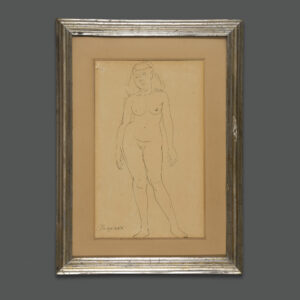
Renato Marino Mazzacurati was born in San Venanzio di Galliera, near Bologna, in 1907 and died in Parma in 1969. After an early artistic education between Padua and Venice, he moved to Rome in 1926 and attended the life-drawing school of the Academy of Fine Arts.
In Rome he came into contact with Francesco Di Cocco, Arturo Martini, Scipione, Mario Mafai and Antonietta Raphaël. His close relationship with Scipione, Mafai and Raphaël placed him within the circle later associated with the Scuola di via Cavour.
Rather than following the official classicism of the Novecento Italiano, Mazzacurati developed a more restless and expressive language. Moreover, his early work reveals an interest in psychological tension, deformation and dramatic contrasts.
In 1931 he founded the short-lived magazine Fronte with Scipione. Although only two issues were published, the project became an important episode in the Roman artistic debate of the period.
Painting, sculpture and experimentation
Mazzacurati worked across painting, drawing, printmaking and sculpture.
From the late 1930s onward, sculpture became increasingly central to his practice. In 1942 he presented a large group of bronzes, terracottas, waxes, wooden works and drawings in Rome. These included portraits of Alberto Moravia, Vasco Pratolini and Alfonso Gatto.
His sculptural language changed repeatedly over the course of his career. Expressionism, Neo-Cubism, realism and abstraction all became part of a deliberately open artistic vocabulary.
The Emperors and criticism of power
Between 1942 and 1945 Mazzacurati created the first series of the Emperors. In these small bronzes, grotesque distortion becomes a powerful instrument of social and political criticism.
At the same time, the experience of war strengthened his civil commitment. After witnessing the effects of a violent bombing in Bologna in 1943, he produced a group of drawings devoted to massacres and the devastation of war.
In 1944 he took part in the exhibition Arte contro la barbarie. From then on, the Resistance, collective memory and the consequences of violence became recurring themes in his work.
Monumental sculpture and the Resistance
After the Second World War, Mazzacurati increasingly conceived sculpture as a public art form.
One of his major works is the Monument to the Italian Resistance in Parma, created between 1954 and 1956 with the architect Guglielmo Lusignoli. In 1956 he also received the International Prize of the Italian Senate at the Venice Biennale.
He later designed monuments for Beirut, Sansepolcro, Mantua and Naples. Among them, the Monument to the Four Days of Naples stands as one of the most significant examples of his commitment to public memory.
Between Expressionism, realism and abstraction
Mazzacurati consistently rejected the idea of a single artistic language.
During his career, he moved between Expressionism, realism, Cubism and abstraction. Nevertheless, this variety remained coherent with his belief that art should respond to different historical and human experiences.
In 1965 he was elected a corresponding member of the Accademia di San Luca. The following year he received the National Sculpture Prize. During his final years, he also taught sculpture at the Academy of Fine Arts in Naples.
He studies in Veneto, then he moves to Rome at a very young age (1926) and he gets involved with the main artists active in Rome at the time.
Mazzacurati frequents Villa Strohl-Fern, where he meets Francesco Di Cocco and Arturo Martini, of whom he becomes personal assistant in 1927 and 1928.
The various artistic influences, from Novecento’s primitivism to the Scuola Romana’s tonalism, enrich his cultural background, which will be completed by a trip to Paris, getting in touch with the most avantgarde European trends, particularly in regards to sculpture. In 1930 with Scipione he funds the “Fronte” magazine, only published twice in 1931. Always loyal to a sacred idea of the trade, he trains with artisans and decorators from Padua. From the 1930s he almost exclusively sculpts. In those years, he produces remarkable critical art pieces against the regime, often infused with scathing and grotesque irony. Political commitment and a reflection on the Resistance will be the underlying theme in all his subsequent production, mainly consisting of figurative pieces and memorials.
Since the 1930s he has devoted himself almost exclusively to sculpture. In those years he produced works with a marked polemical accent against the regime, often pervaded by biting and grotesque irony.
Political commitment and reflection on the Resistance will be the common thread linking his later artistic production, producing mainly figurative works and memorials.
You have a work by Renato Marino Mazzacurati and you want to sell it?
Call us at +39 3356585431 or send us a message on WhatsApp at +39 3356585431
YOU CAN TRUST US
The highest valuations, expertise, and reliability
Appraisals, purchases and sale of the works by this artist