


A young woman walks down a stone staircase with her basket. Travelers gather along a village street. A tree at the edge of a field holds our attention before the eye moves toward the horizon. Through familiar subjects, 19th-century paintersinvite us into worlds shaped by light, color, and their own ways of seeing.
Across Italy and Europe, this attention to the visible world took many forms. Landscapes, portraits, and scenes of daily life became opportunities to express an individual sensibility. The works available at Egidi MadeinItaly offer a closer encounter with this period and the chance to discover a painting that speaks to you.
19th-century painters and artistic exchange in Europe
The nineteenth century brought together artistic approaches that developed alongside one another. History painting and Romanticism coexisted with the study of nature, an interest in society, and new ways of depicting light. Each painter responded through a distinctive combination of training, experience, and ambition.
In Italy, the relationship between art and national history found a celebrated expression in Francesco Hayez’s The Kiss. Presented at Brera in 1859, the painting brings together romantic feeling and patriotic meaning. This connection also runs through the works discussed in our article on Risorgimento painting in Italy.
Meanwhile, travel and exchanges between artistic centers widened painters’ horizons. Giuseppe De Nittis, who worked in Naples, Paris, and London, offers a revealing example. As the Petit Palais explains in its account of the artist, he observed modern life while responding to the contrasting light and atmosphere of European landscapes.
Within 19th-century European painting, genre scenes offered many ways to tell a story. A gesture might suggest a person’s character. Clothing, posture, and exchanged glances could make an encounter immediately recognizable. Looking closely at these details allows the narrative to unfo
Everyday life in Britain and Italy
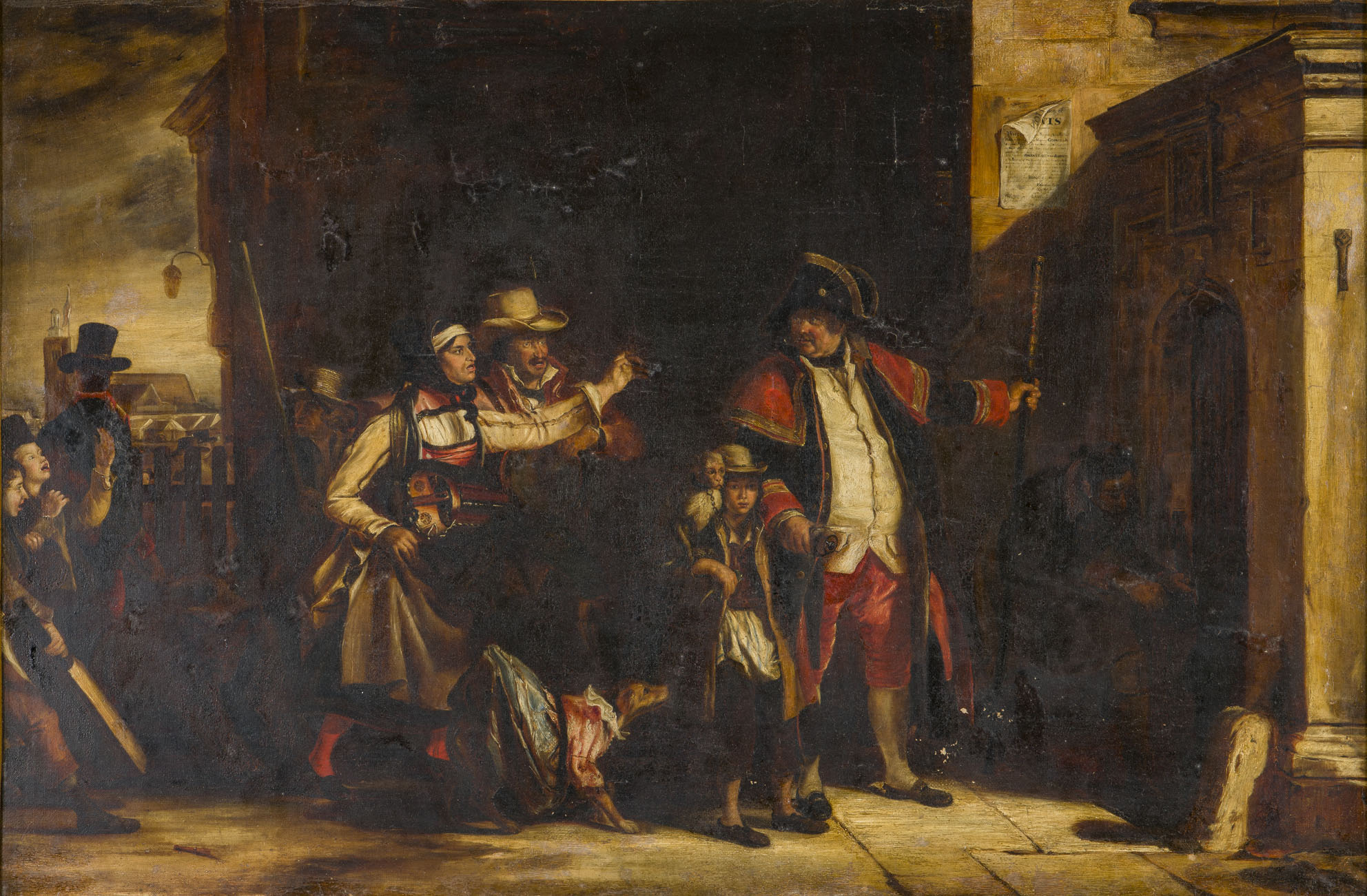
David Wilkie’s The Parish Beadle, a parish official leads away a group of itinerant performers from Savoy. The contrast between his authority and the lively company gives the scene a quietly ironic tone. Clothing, musical instruments, and animals add to the movement of the composition.
The oil on canvas offered by the gallery dates to around 1820–1823 and is cataloged as a full-scale sketch for the painting at Tate Britain. It provides an opportunity to consider Wilkie’s preparatory work and the way he brought a crowded narrative into focus.
A more intimate atmosphere emerges in Girl with Basket by Pio Joris, an oil on canvas from the late nineteenth century. The young woman passes through a lane in the Roman countryside, framed by steps and old walls. Light on the masonry and chickens in the foreground give the scene its everyday character.
These paintings invite different kinds of attention. Wilkie draws us into the relationships between several figures, while Joris concentrates on a passing moment. For collectors drawn to scenes of daily life, that difference in narrative feeling can help guide a choice.
Three perspectives on the Italian landscape
19th-century landscape paintings offer a remarkable variety of experiences. A place may be recognizable through its buildings or vegetation, or simply through the way light moves across it. Looking at a painted landscape also means noticing the decisions that give it structure.
In Liguria, Tammar Luxoro contributed to the naturalistic approach associated with the Scuola dei Grigi. His Landscape with Figures, a signed nineteenth-century oil on canvas, offers an introduction to this landscape tradition. The relationship between the setting and its human presence provides a starting point for exploring the work.
Sante Nucci’s Landscape of 1863 offers a different approach. A road leads toward a small settlement, while figures, trees, and distant hills establish a sense of depth. This signed and dated painting encourages the eye to move from the foreground toward the lighter tones of the distance.

The Landscape painted by Ugo Gheduzzi in 1881 adds an oil on canvas mounted on cardboard to the selection. Comparing these works brings attention to their formats, the distribution of light, and the relationship between the painted surface and its support.
In Tuscany, the Macchiaioli provide another essential reference for understanding the period’s commitment to direct observation. Such regional comparisons enrich our experience of landscape painting while preserving each artist’s individual character.
Portraiture and the classical imagination
Alongside their observations of contemporary life, nineteenth-century painters continued to draw on the ancient world. Clothing, attributes, and poses could suggest an ideal identity while leaving the subject open to interpretation.
In Portrait of a Young Man with a Laurel Wreath by Jean Georges Pasquet, the red drapery and laurel wreath evoke classical culture. The dark background concentrates attention on the face and the light that models its features.
The French painter’s work holds our attention somewhere between portrait and idealized image. For a collector, part of its appeal may lie in that openness: the painting invites repeated looking without revealing all its meaning at once.
Observation and imagination in Naples
Watercolor introduces a different relationship between paint and surface. Transparent washes allow the paper to contribute to the image, while delicate variations in tone give the figure its presence. Each touch plays a part in the balance of the whole.
Domenico Morelli’s Donna con otre, or Woman with a Waterskin, is a signed watercolor on paper associated with Neapolitan Orientalism. The subject of a woman at a well opens a path into the relationship between the human figure and the imagined settings explored by painters in Naples.

Francesco Paolo Michetti trained in the same artistic environment, studying with Morelli in Naples while retaining a lasting attachment to Abruzzo. His participation in the Paris Salons of 1872 and 1875 shows how local roots could coexist with an international career.
These connections reveal the diversity of 19th-century Italian painting. Artists who shared a place of study could develop very different paths, shaped by encounters with other traditions and ways of working.
The legacy of the nineteenth century in a new era
Many artistic careers continued across the turn of the century. Painters developed subjects and approaches formed in the previous decades, adapting them to new experiences. The works in this section date from the early twentieth century and allow us to follow that continuity.
In Roman Countryside Landscape by Filiberto Petiti, dated to the early twentieth century, a tree draws the eye into the open fields. This small oil on panel preserves the intimacy of a quiet encounter with the landscape of Lazio.
Monza Countryside by Emilio Borsa, painted around 1920, presents a scene dominated by a bare willow and a restrained palette. A bridge over the Lambro River, visible in the distance, connects the view to the artist’s local surroundings.
Antonio Mancini’s female figure in pastel, dated 1917–1921 and registered with the Archivio Antonio Mancini, brings a different expressive intensity. The face emerges from swift blue marks. Across the sheet, the figure takes shape through the movement and density of the pastel.

A dialogue with sculpture
The selection also includes Ebrezza by Costantino Barbella, a bronze depicting a woman reclining on a bed of roses. It bears Barbella’s signature, the inscription “Roma Domenica delle Palme 31 III 1912,” and the mark of the Laganà foundry in Naples. Dated 1912, the sculpture extends this exploration into another medium, offering a different way of shaping the human figure.
Choosing a work to live with and collect
Choosing a painting often begins with a sense of affinity. It may be a light that recalls a place, a figure that holds your attention, or a composition that finds its natural setting in your home.
When considering 19th-century paintings for sale, that first response is accompanied by a closer examination of the work. Medium, dimensions, condition, and available documentation all help clarify its character. The frame and the distance from which a painting will be viewed also shape the experience of living with it.
The linked artwork pages provide details of the works offered by Egidi MadeinItaly. Contact the gallery to explore a painting further, request additional photographs, or compare two works. We will help you make your choice and discuss the arrangements for purchase and shipping.
→ Contact us about the artworks and your purchase