


Artists and writers in interwar Rome
Caffè Aragno in Rome was a meeting place where art, literature, and criticism shared the same tables. Its history opens a window onto the cultural world surrounding the Scuola Romana, or Roman School.
Opened in 1886, the café occupied rooms in Palazzo Marignoli on Via del Corso. Painters, writers, and journalists helped make it a lively center of Roman intellectual life.
The Terza Saletta: art and conversation
The café’s most celebrated room was the Terza Saletta, literally the “Third Room.” Here, established figures and younger voices gathered to discuss painting, poetry, theater, and the changing direction of Italian culture.
Writing in 1938, journalist Orio Vergani recalled its exceptional place in Rome’s artistic and literary life.
Debates embraced Futurism, the return to order, and the ideas circulated by the journals Valori Plastici and La Ronda. Different generations met here, each bringing its own understanding of modern art.
Amerigo Bartoli’s Gli amici al caffè
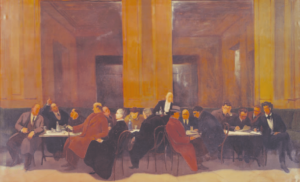
Painted in 1930, Amerigo Bartoli’s Gli amici al caffè brings this social world into focus. The work belongs to the Galleria Nazionale d’Arte Moderna e Contemporanea in Rome.
Among the figures are Emilio Cecchi, Vincenzo Cardarelli, Carlo Socrate, Ardengo Soffici, Giuseppe Ungaretti, and Roberto Longhi. The scene also includes Mario Broglio, Riccardo Francalancia, Bartoli himself, and the waiter Malatesta.
Gathered around café tables, these personalities give a human face to Rome’s cultural history. Bartoli transforms a familiar interior into a record of friendships, encounters, and shared intellectual life.
Caffè Aragno and the Scuola Romana
The café’s history also includes disagreement. In 1930, Scipione published a caricature of Bartoli’s painting in L’Italia Letteraria.
His satire suggests the distance that some younger artists felt from Aragno’s established circle. The café therefore helps us understand the exchanges and generational tensions surrounding the development of the Scuola Romana. Its significance lies in this variety of voices, from literary tradition to the search for new forms of expression.
Palazzo Marignoli restored artworks and historic interiors
In May 2021, Apple Via del Corso opened inside Palazzo Marignoli following a major restoration.
The project included engraved panels created by Afro Basaldella in 1950. These works belong to a later chapter in the café’s history and preserve another aspect of its artistic identity.
→ Discover Afro Basaldella’s engraved panels
Restorers also worked on Alba (Dawn) by Fabio Cipolla and Crepuscolo (Dusk) by Ettore Ballerini. Both are large ceiling paintings dating from the early twentieth century.
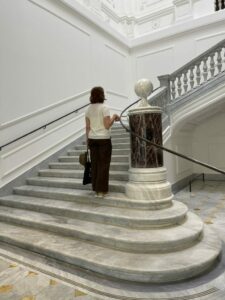
The palace’s monumental Carrara marble staircase, dating to 1888, also survives within the restored interior.
→ Read about the restoration of Palazzo Marignoli
Explore Italian modern art
The history of Caffè Aragno brings paintings into dialogue with the places and people behind them. Continue exploring Italian artistic culture through the works presented in our modern art catalog.