The Scuola Romana, or Roman School, encompasses a range of painters and sculptors active in twentieth-century Rome. Its history took shape between the World Wars and continued, through individual artists’ careers, after 1945. Mario Mafai, Antonietta Raphaël, Scipione, and Antonio Donghi reveal the breadth of its artistic approaches.

Scuola Romana artists between the World Wars
The name brings together artists connected through Rome, friendships, and shared meeting places.
In 1933, critic Waldemar-George used the term “École de Rome” in connection with an exhibition of Corrado Cagli, Giuseppe Capogrossi, and Emanuele Cavalli at the Galerie Jacques Bonjean in Paris.
These artists developed personal visual languages, often distant from the monumental rhetoric of official art. Their relationships with cultural institutions and the Fascist regime nevertheless varied.
Rome, its transformation and its meeting places
Portraits, still lifes, and cityscapes were central to their work. Rome could appear quiet and familiar, or unsettling and visionary.
The city’s transformation became a particular concern for Mario Mafai. His Demolizioni paintings evoke neighborhoods disrupted by the demolitions of the 1930s.
Artists exchanged ideas in studios, including those at Villa Strohl Fern, as well as in cafés and galleries. Caffè Aragno, Caffè Greco, and the Galleria d’Arte di Roma formed part of this cultural landscape.
Founded in 1935 by Anna Laetitia Pecci Blunt, the Galleria della Cometa also became an important venue, with contributions from Libero de Libero and Corrado Cagli.
Scuola Romana Artists and Their Approaches
Italian Magical Realism
Antonio Donghi is a leading figure in Italian Magical Realism. His precisely rendered figures and objects appear suspended in a still, timeless atmosphere.
Francesco Trombadori and Riccardo Francalancia explored other forms of figurative painting rooted in everyday subjects. Ferruccio Ferrazzi followed a more visionary path, with Expressionist qualities.


In these paintings, though the reality of things and people is represented in detail, this reality is suspended in timelessness.
The Via Cavour School Mafai, Raphaël, and Scipione
The Via Cavour School centered on Mario Mafai , Antonietta Raphaël, and Scipione, the pseudonym of Gino Bonichi. Roberto Longhi used the name in 1929.
Mafai and Raphaël’s home and studio provided a meeting place. Expressive color, imagination, and emotional intensity shaped their work, while each artist retained a distinct approach.


Roman Tonalism
During the 1930s, Corrado Cagli, Giuseppe Capogrossi, Emanuele Cavalli, Roberto Melli, and Guglielmo Janni investigated the relationship between color, light, and space.
Roman tonalism builds forms through relationships between color tones. Figures and objects become part of the composition’s overall chromatic balance.


Realism and Figurative Painting
By the late 1930s, Alberto Ziveri was moving toward a more direct form of realism. Fausto Pirandello developed a dense and highly personal figurative language.
Renato Guttuso, followed by the younger Renzo Vespignani, gave human and social experience an important place in their work during the war and postwar years. Their individual paths expanded and renewed Rome’s artistic scene.

Sculpture and Printmaking
Sculpture also played an important role. Antonietta Raphaël, Pericle Fazzini, Mirko Basaldella, Leoncillo Leonardi, and Renato Marino Mazzacurati explored the body, materials, and expression in different ways.
In printmaking, Luigi Bartolini made a distinctive contribution to this artistic history.
For further context, explore the Vatican Museums’ introduction to Rome and the Roman School.
An Antonio Donghi Watercolor Available from the Gallery
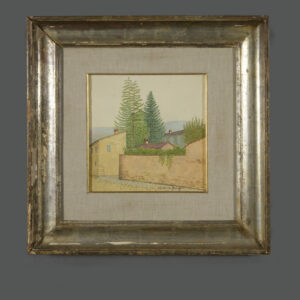
Egidi MadeinItaly currently offers Paesaggio by Antonio Donghi, a watercolor on paper dating to around 1955.
Signed at the lower right, it is accompanied by a certificate from Professor Rivosecchi. Houses, a wall, and trees form a restrained, balanced landscape.