


The house studio and the name of the Via Cavour School
In 1927, Mafai and Raphaël moved to 325 Via Cavour. Their apartment soon became a meeting place for Scipione, Renato Marino Mazzacurati and writers including Giuseppe Ungaretti and Leonardo Sinisgalli.
The Via Cavour studio brought these friendships into particularly close contact in 1928 and 1929. In 1929, critic Roberto Longhi introduced the name Scuola di via Cavour while reviewing the Prima Sindacale del Lazio exhibition. The term described a shared artistic experience and sensibility, rather than a school with formal teaching.
Mario Mafai and Scipione
The friendship between Mario Mafai and Scipione, whose real name was Gino Bonichi, began in 1924. They attended life drawing classes at Rome’s Academy of Fine Arts. They also studied painting at the art history library in Palazzo Venezia.
These shared interests led to distinct artistic paths. Mafai became increasingly attentive to light and the relationships between colors. Scipione, meanwhile, created a visionary world in which Roman figures and places acquired an intense emotional presence.
Antonietta Raphaël in Rome
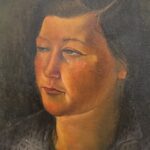
The arrival of Antonietta Raphaël in Rome brought a different cultural experience to the group. Born in Lithuania, she spent her youth in London, where she studied music. After a stay in Paris, she reached Rome and began a long artistic and personal relationship with Mafai.
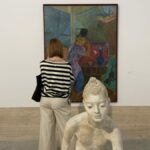
Her international background encouraged the group’s expressive freedom. In her paintings, personal memories and imagination meet through vivid color and forms that depart from academic conventions. In later years, sculpture became central to her work.
Raphaël’s contribution therefore deserves recognition through her own achievements as a painter and sculptor, as well as her exchanges with Mafai and Scipione.
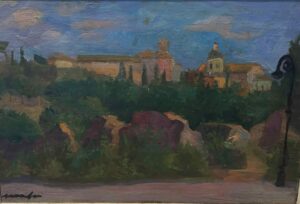
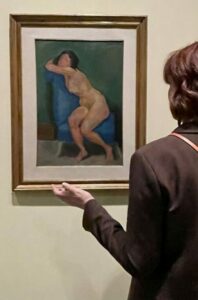
Color, imagination and artistic freedom
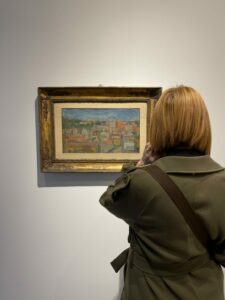
Roman expressionist painting found a distinctive voice in these artists’ work. Color conveys emotion, while forms move beyond literal likeness to express unease, affection or memory.
Compared with the more classicizing tendencies of the period, the Via Cavour artists favored a personal vision. Each, however, retained an individual voice that continued to develop.
The works from the 1940s reproduced here belong to that later development. They should be viewed as part of the artists’ evolving careers, beyond the group’s formative years.
Rome and the memory of its places
Rome shaped this experience as a place to live, work and imagine. The house studio was demolished during the urban transformations around 1930. Paintings of the city also preserve the memory of places that were about to change.
In the following years, Mafai explored the demolitions of Rome directly. His paintings record the changing city through light, silence and traces of everyday life.
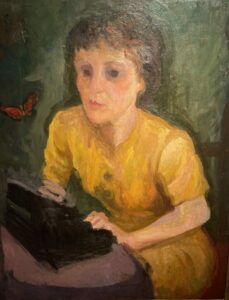
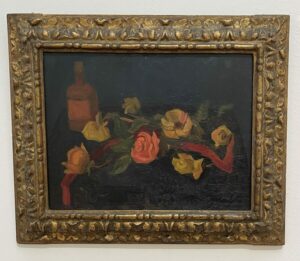
Discovering and collecting twentieth-century art
The Via Cavour School offers a compelling introduction to Italian art between the two world wars. Learning about the artists and looking closely at their work can also enrich a collector’s choices.
Explore the modern art selection at Egidi MadeinItaly and contact us for information about works that interest you.
Works in the Egidi MadeinItaly catalog
Our catalog presents two works on paper by Antonietta Raphaël. Alberi (Trees), 1956, executed in ink and watercolor, is signed and bears the place and date inscription “Raphael, Abbadia 15.8.56”.
It is accompanied by an artist’s proof lithograph, signed in pencil and inscribed “Roma 70”. The selection also includes a Female Nude by Renato Marino Mazzacurati, a pencil drawing on paper.