


Riccardo Licata was born in Turin in 1929 and died in Venice in 2014. An Italian artist whose practice embraced painting, engraving, mosaic, sculpture, glass, tapestry and stage design, he developed an unmistakable abstract language based on signs, rhythm and the organisation of space. Over the course of his career, Licata created a personal graphic alphabet composed of symbols and “imaginary letters”, establishing a visual vocabulary that remained central to his work.
Training between Venice and Paris
After spending part of his childhood between Paris and Rome, Licata settled in Venice, where his artistic education took shape. Giuseppe Mazzariol encouraged him to pursue formal art studies, while his contact with Romualdo Scarpa introduced him to mosaic, a technique that would become fundamental to his artistic development.
The cultural environment of post-war Venice, open to abstraction and experimentation across different media, played a decisive role in his formation. Alongside painting and mosaic, Licata began to devote increasing attention to graphic art and engraving, developing a progressively more autonomous language based on the expressive possibilities of the sign.
Licata and Venetian Spatialism
During the 1950s Riccardo Licata worked within the cultural climate of Venetian Spatialism, sharing its interest in moving beyond traditional representation and in exploring new relationships between space, matter and sign.
Although he was not among the signatories of the Spatialist manifestos, his work developed in close dialogue with the artistic environment in which Mario Deluigi, Edmondo Bacci, Tancredi, Vinicio Vianello and Gino Morandis were also active.
Licata nevertheless maintained an independent position, gradually developing a language centred on sign, rhythm and the construction of pictorial space.
The sign as a language
One of the most distinctive aspects of Riccardo Licata’s work is the creation of an autonomous visual grammar. Short marks, sequences, small modules and forms suggestive of writing are distributed across the surface according to relationships of balance, tension and rhythm.
Over time, the artist developed a personal graphic alphabet composed of symbols, signs and what he called “imaginary letters”. The pictorial surface thus becomes a space articulated through pauses, repetitions and variations, with a structure that evokes both writing and music.
Although his research developed in dialogue with Informal Art, it retained a strong constructive component. The sign is never merely gestural, but is organised within a precise structure through which Licata created a highly recognisable personal language.
Painting, engraving and mosaic
Licata worked continuously across different media. Painting and drawing maintained a close dialogue with engraving, mosaic, tapestry and painted glass.
From the 1950s onwards, printmaking became one of the privileged areas of his investigation into the sign. Engraving allowed him to develop sequences, rhythms and spatial structures with particular precision. The Museum of Modern Art in New York preserves his 1955 etching XXXII, an early example of the importance of graphic art within his work.
Mosaic was equally significant. Through tesserae, colour and reflected light, Licata was able to translate the sign into matter and architectural space. Mosaic should therefore not be considered a secondary activity, but an integral part of the development of his visual language.
Riccardo Licata and the Venice Biennale
Licata maintained a long relationship with the Venice Biennale. From the early 1950s onwards, his work appeared in various editions and in different sections, reflecting the interdisciplinary character of his practice. Painting, engraving, mosaic and the applied arts were not separate fields in his work, but different expressions of the same investigation into rhythm, sign, colour and space.
Paris and teaching
Paris represented another fundamental centre in Licata’s career. There he deepened his knowledge of engraving and came into direct contact with the European artistic climate of the post-war period.
His activity as an artist was accompanied by an important teaching career in France, particularly in the field of mosaic. This academic experience continued for several decades and developed alongside his own artistic research.
Stage design and applied arts
Licata’s research extended well beyond painting and printmaking. He also worked with glass, tapestry and stage design, transferring his system of signs and rhythms into different materials and dimensions. This versatility reveals the essentially interdisciplinary nature of his work. Whether applied to paper, canvas, mosaic, glass or the theatrical space, his language remained recognisable through the organisation of signs, colour and rhythm.
Works in public collections
Works by Riccardo Licata are held in important public and institutional collections in Italy and abroad. His long exhibition history and his activity in Venice and Paris contributed to the international circulation of his work.
A work by Riccardo Licata in the gallery
Egidi MadeinItaly presents a work on paper by Riccardo Licata dated 1974, executed in watercolour and felt-tip pens, signed and dated by the artist.
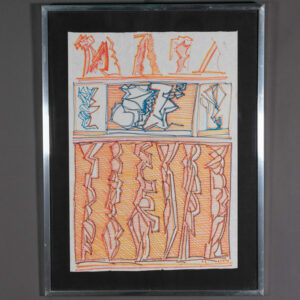
The work belongs to the mature phase of his investigation into the sign, with graphic elements arranged across the surface according to a visual rhythm that recalls both writing and musical notation.
You have a work by Riccardo Licata and you want to sell it?
Call us at +39 3356585431 or send us a message on WhatsApp at +39 3356585431
YOU CAN TRUST US
The highest valuations, expertise, and reliability
Appraisals, purchases and sale of the works by this artist