


Two of the artist’s own remarks offer the perfect starting point for a reflection on the Anselmo Bucci exhibition at the Mart in Rovereto. Their wit reveals something of his character and his way of looking at the world:
“Christ began his career between the donkey and the ox; I hope to end mine in much the same way.”
With just a few words, Bucci opens a window onto his very personal world. It is a world that can be beautiful and sublime, yet crossed by deep currents of melancholy.
There is nature in its purest form. The elegant women whose penetrating gaze seems to allow no escape.
There is also an ideal world governed by natural harmony. Beside it stands a real world that changes almost monstrously beneath the artist’s balcony.
Above all, however, there is the world of his beloved animals. In Bucci’s eyes, they know nothing of sin and simply know how to love.
“Tired of searching in vain for a contemporary who was neither a genius nor a hero, I took refuge among the beasts.”
The Mart in Rovereto presents the most comprehensive exhibition ever devoted to Anselmo Bucci. Curated by Beatrice Avanzi and Luca Baroni, it runs from 28 March to 27 September 2026. More than 150 works reconstruct the career, life and cultural relationships of this singular artist. Paintings, prints, drawings, photographs and archival material reveal a painter who was also an exceptional printmaker, draughtsman and writer.
Further details are available on the Mart’s official exhibition page.
Anselmo Bucci, painter and intellectual of the twentieth century
Anselmo Bucci was born in Fossombrone, in the Marche, in 1887 and died in Monza in 1955.
Active between Paris and Milan, he became one of the most cultivated and independent figures of twentieth-century Italian art. He was among the founders of the Novecento Italiano and was responsible for giving the group its name. Yet he never allowed a movement to define the limits of his work.
His artistic language remained open, eclectic and unmistakably personal. Alongside the solid construction and modern classicism associated with the Novecento Italiano, he developed Post-Impressionist atmospheres, often painted en plein air. His compositions also reveal an unusual interest in daring viewpoints and perspectives.
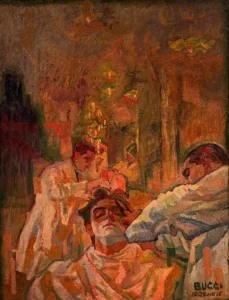
The enduring bond with his native land
Bucci sometimes signed himself “Bucci da Fossombrone”, underlining his profound attachment to his birthplace. The Marche remained a landscape of memory, family ties and roots throughout his life. Even during his most cosmopolitan years, he never entirely abandoned that emotional geography.
This intimate connection emerges in L’Autunno, one of the major paintings of his early Parisian period. Nature is not simply a setting. It becomes a place of memory and inner reflection.
The Paris years: training and international recognition
Anselmo Bucci arrived in Paris in November 1906 with his friends Mario Buggelli and Leonardo Dudreville.
He later recalled their arrival with characteristic irony:
“Altogether, we were fifty-eight years old, with three suitcases, one address and twelve francs between us.”
Bucci lived in Paris for eight years. Even after returning to Italy, however, he maintained a studio and a close network of friendships there until the mid-1930s.
Paris became the city of his artistic maturation and early recognition.
During his first years he frequented the bohemian environment of La Ruche in Montparnasse. There he encountered artists including Gino Severini, Amedeo Modigliani, Lorenzo Viani, Pablo Picasso and Maurice Utrillo.
He supported himself by retouching photographs, producing portraits and working intensively as a printmaker.
Among his finest achievements from these years is the series of drypoints Paris qui bouge. In these works Bucci explored streets, cafés, squares, rooftops and the restless movement of modern Paris.
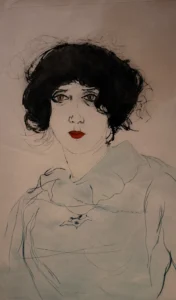
A recurring presence in his early work was Juliette Maré, his companion and muse. Bucci portrayed her in elegant dresses and in costumes inspired by Japanese fashion.
Between 1909 and 1914 he also travelled extensively. His journeys took him to southern France, Sardinia, Brittany and Algeria. New landscapes, colours and qualities of light entered his artistic vocabulary.
Graphic art and the mastery of drypoint
One of the most significant sections of the Mart exhibition is devoted to Bucci’s graphic work.
An inventory compiled by the artist in 1936 recorded 6,910 drawings and 417 engraved plates. These figures alone reveal the extraordinary intensity of his work on paper.
Drypoint was not a secondary activity for Bucci. It was one of the principal languages through which he observed modern life.
His prints combine technical precision with speed of perception. Streets, crowds, animals and fleeting gestures become fragments of a world caught in motion.
Cities seen from above
The elevated viewpoint is one of the most recognisable features of Bucci’s work.
He often chose homes and studios on upper floors. From windows, balconies and terraces he observed the city and its continuous transformations.
In Tetti di Parigi, snow and mist dissolve the urban structure. The city becomes an interior landscape dominated by grey, silent tonalities.
After his return to Italy, the rapid development of Milan offered Bucci a new field of observation.
From the balcony of his studio in Via Jean Jaurès, overlooking the railway tracks near the Central Station, he witnessed countryside gradually being transformed into city.
The urban landscape therefore became more than a subject. It provided a stage on which Bucci could explore the tensions and dramas of contemporary life.
One of the most significant works in this context is Il lampo. The painting was presented at the Venice Biennale in 1922. A sudden flash interrupts the apparent calm of the Milanese outskirts, frightening the horses and sending passers-by towards shelter.
The remarkable portraits of Anselmo Bucci
Bucci’s interest in portraiture can be traced back to his childhood years in Este.
In Paris, portraiture also helped him establish important professional relationships. After his return to Italy, it became an important point of contact with Milanese society.
The monumental Ritratto di signora in blu revisits the nineteenth-century tradition of the full-length seated portrait. Elsewhere, Bucci adopted a frontal half-length format closer to contemporary photography and postcards.
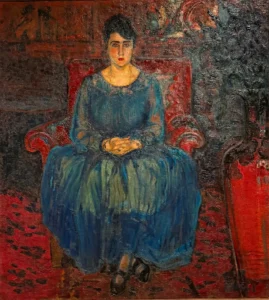
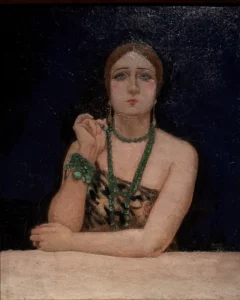
Portraits such as those of Anita, Cipriano Efisio Oppo and Elena Fambri belong to this approach.
Particularly intense is Rosa Rodrigo, also known as La Bella. The sitter’s presence is direct and self-possessed. Bucci avoids anecdote and concentrates instead on character.
Anselmo Bucci and the Novecento Italiano
Bucci was one of the founders of the Novecento Italiano, supported by the critic and intellectual Margherita Sarfatti.
The movement sought a renewed figurative tradition based on solid form, compositional order and a modern sense of classicism. This ambition emerged after the radical transformations introduced by the avant-gardes.
Bucci, however, brought a distinctly European experience to this cultural project.
His knowledge of the Old Masters existed alongside his Parisian training, Post-Impressionist influences and experience of painting en plein air.
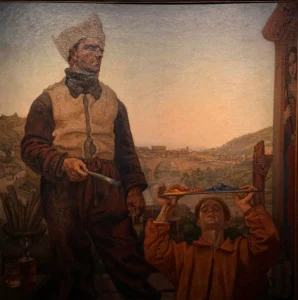
One of the most representative works of this period is I Pittori. It was shown at the Venice Biennale in 1924, in the section devoted to the painters of the Novecento.
Bucci depicts himself working on the walls of a church. Behind him opens a luminous view of Fossombrone.
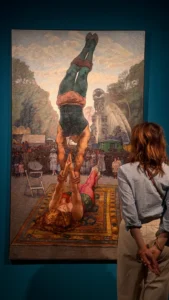
His interest in unusual spatial constructions also appears in I Giocolieri. Here a group of performers is arranged
through complex and highly controlled poses.
In La Scuola, by contrast, the young pupils of Bucci’s sister are organised within a rigorous architectural perspective. Seen together, these works helped the Anselmo Bucci exhibition illuminate the artist’s personal approach to the Novecento Italiano, shaped by both Italian tradition and his years in Paris.
Nature, animals and the illustrations for Kipling
Bucci’s relationship with animals was emotional, artistic and deeply personal.
During his Paris years he adopted two wolf-dog puppies, Baloo and Loute. They appear in numerous drawings and prints.
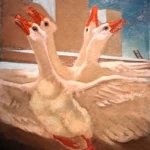
Later, in Milan, his unusual domestic companions included a tortoise named Pupa and a goose called Gertrude.
Gertrude inspired Le oche del Campidoglio. In this painting Bucci revisited, with unmistakable irony, an episode from Roman history that had often been appropriated by Fascist propaganda.
Around 1924 he began working on a group of drypoints inspired by Rudyard Kipling’s The Jungle Book. The project became one of the finest expressions of his interest in the animal world.
The cycle connected Bucci’s skill as a draughtsman with his literary imagination. Works inspired by Kipling were presented at the Venice Biennale in 1926.
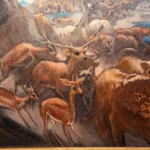
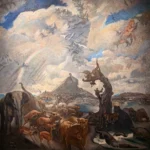
This research culminated in major animal compositions such as Uscita dall’Arca. The work was exhibited at the Venice Biennale in 1928.
I Maschi: a monumental and unfinished obsession
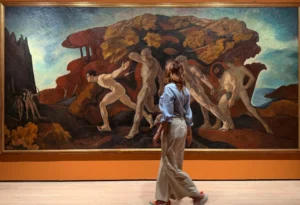
Among Bucci’s most ambitious creations is I Maschi.
The monumental canvas was conceived in Paris in 1911 and reworked several times until 1924. The Mart therefore dates the work 1911–1924.
This composition stages a violent encounter between men and Amazons. The subject is mythological, but its meaning is far from remote.
The early conception was brighter and more decorative. When Bucci returned to the painting in the early 1920s, however, its language became darker, more synthetic and closer to the aesthetic climate of the Novecento Italiano.
Bucci considered presenting the work at the 1924 Venice Biennale but ultimately chose other paintings.
He nevertheless kept I Maschi throughout his life and succeeded in saving it from the bombing that destroyed his Milan studio during the Second World War.
Restored for the Anselmo Bucci exhibition, I Maschi formed the final stage of the display at the Mart. This was the monumental painting’s first presentation in a museum.
Perhaps no other work brings together so many aspects of Bucci’s personality. There is ambition, irony, physical tension and melancholy. Above all, there is the independence that made him one of the most fascinating and elusive figures of the Italian twentieth century.
Continue exploring twentieth-century painting through our introduction to modern art.