


A bold 1950s contemporary art gallery
In 1957, along the historic Via Appia Antica in Rome, one of the most original experiments in postwar Italian art began to take shape. The Galleria Appia Antica grew out of an idea by the painter Enrico Cervelli and was developed by Liana Sisti, owner of the property at Via Appia Antica 20 and director of the gallery.
Moreover, the decisive critical contribution of Emilio Villa gave the space a distinctive identity. Far from the traditional art district around Via Margutta, the gallery became a meeting place for young artists and new experimental practices.
The Birth and Historical Context of Galleria Appia Antica
The gallery opened in 1957 in a country house at Via Appia Antica 20, where Enrico Cervelli had already established his studio. Liana Sisti, who owned the property, became the gallery’s director.
In this context, the location itself was significant. The space stood outside Rome’s conventional gallery circuit and created an unusual dialogue between the archaeological landscape of the Appian Way and the most advanced artistic research of the period.
The “Roman-style merende”
Instead of formal cocktail receptions, the gallery became known for its informal “Roman-style merende”. These gatherings contributed to the relaxed and convivial atmosphere of the space.
Thus, exhibitions were conceived not only as public events but also as opportunities for dialogue between artists, critics and collectors.
Emilio Villa and the Critical Direction
Emilio Villa played a central role in shaping the intellectual identity of Galleria Appia Antica. Poet, critic, translator and scholar, he supported artistic research that resisted both academic conventions and the simplifications of the market.
In particular, Villa was interested in artists who explored matter, image and the physical presence of the artwork. His influence helped transform the gallery into one of the most experimental cultural spaces in Rome at the end of the 1950s.
The magazine Appia Antica. Atlante di Arte Nuova
Closely connected with the gallery was the experimental contemporary art magazine Appia Antica. Atlante di Arte Nuova. It was published by Liana Sisti and Mario Ricci and directed by Emilio Villa.
The first issue appeared in July 1959. Later, a second international issue, open to American art, was published in January 1960. The magazine is now an important document for understanding the artistic debates surrounding the gallery and the transition towards the new research of the 1960s.
Artists and Exhibitions at Galleria Appia Antica
During the 1957–1959 exhibition period, Galleria Appia Antica presented artists who would become important figures in postwar Italian art. The programme reflected a particular interest in matter, abstraction and the transformation of the traditional painted surface.
Alberto Burri
Alberto Burri’s radical investigation of matter and surface provided an essential reference for the experimental climate promoted by the gallery. His works challenged conventional distinctions between painting, object and material.
Mario Schifano
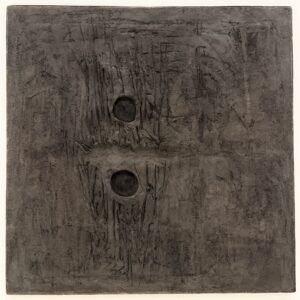
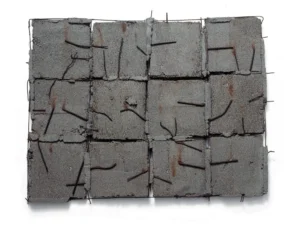
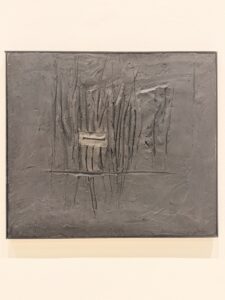
In 1959, Mario Schifano held his first solo exhibition at Galleria Appia Antica, with a presentation by Emilio Villa. The works belonged to an early material and Informal phase, characterised by the use of plaster, sand, cement and other unconventional materials.
Therefore, this exhibition marked an important stage in Schifano’s development before the monochrome works that would define his research in the early 1960s.
Mimmo Rotella
Through his décollages, Mimmo Rotella transformed torn advertising posters and fragments of the urban environment into the material of the artwork. In this way, images taken from modern city life entered directly into contemporary painting.
Other artists associated with the gallery included Giuseppe Uncini, Francesco Lo Savio, Renato Mambor, Nuvolo, Nino Franchina, Agostino Bonalumi, Enrico Castellani, Taku Iwasaki and others.
The Legacy of Galleria Appia Antica in Postwar Italian Art
Although its activity was brief, Galleria Appia Antica played an important role in the artistic transformation of postwar Rome. It offered young artists an independent space in which to experiment with matter, abstraction and new forms of image-making.
Moreover, the gallery created a direct relationship between artistic research, critical debate and the extraordinary archaeological setting of the Appian Way.
Its importance was reassessed in 2021 through the exhibition Un Atlante di arte nuova. Emilio Villa e l’Appia Antica, held at the Complesso di Capo di Bove. The exhibition reconstructed the events of the gallery’s 1957–1959 programme and highlighted its role in the development of a new generation of Italian artists.