


The myth of Danaë
Danaë was the daughter of Acrisius, king of Argos. When an oracle foretold that he would die at the hands of his grandson, Acrisius confined her to prevent her from having a child. Zeus nevertheless reached Danaë in the form of a shower of gold. Their son, Perseus, would become one of the best-known heroes of Greek mythology.
The image of the golden rain has fascinated artists for centuries. It gives visible form to a divine encounter while leaving room for different interpretations of Danaë: her isolation, vulnerability and place within a story shaped by prophecy and power.
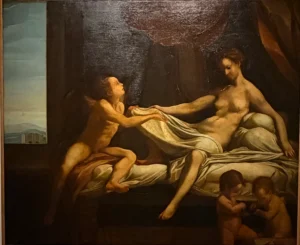
Danaë in painting
Artists have approached the subject in markedly different ways. Titian’s celebrated Danaë demonstrates how the myth became an important theme in Renaissance painting. Later artists continued to reinterpret the moment when Zeus appears as golden rain.
A painting formerly in our gallery
Our gallery previously presented an early seventeenth-century oil on canvas depicting Danaë and the Golden Rain, attributed to a Venetian follower of Jacob de Backer. The painting has been sold, but its catalogue entry remains available for readers interested in the work and its documented details.
→ Explore other antique works of art in the gallery.