


The Exhibition at Villa Mimbelli
The Giovanni Fattori exhibition was held at Villa Mimbelli in Livorno from 6 September 2025 to 11 January 2026. Curated by Vincenzo Farinella, it brought together more than 200 paintings, drawings and etchings to celebrate the bicentenary of the artist’s birth. The exhibition occupied 24 rooms and followed a chronological itinerary. Moreover, Luigi Cupellini’s exhibition design created a dialogue between Fattori’s works, the historic interiors and the original furnishings of the villa.
From Academic Training to the Macchiaioli Revolution
The exhibition began with Fattori’s early works, still influenced by Florentine academic painters such as Giuseppe Bezzuoli and Enrico Pollastrini. However, these paintings already reveal his desire to move beyond academic conventions. His encounter with Nino Costa in 1859 proved particularly important and encouraged his first experiments with the macchia. Over time, Fattori developed an increasingly direct and modern approach to reality.


The Castiglioncello School and Tuscan light
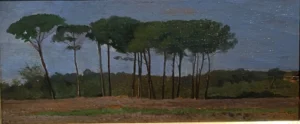
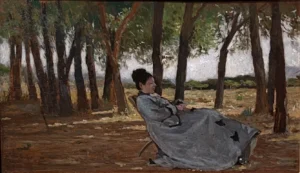
The first floor explored the mature season of the Macchiaioli and Fattori’s relationship with Castiglioncello. In 1867, Fattori joined the circle of artists who gathered at Diego Martelli’s estate, an important meeting place for painters such as Giuseppe Abbati, Odoardo Borrani and Raffaello Sernesi.
There, Fattori deepened his study of landscape, natural light and painting en plein air. His stays at Castiglioncello produced some of the most lyrical works of his career. Among them are La Signora Martelli a Castiglioncello, painted around 1867, and numerous small landscapes executed directly from nature.
Thus, Castiglioncello became a crucial stage in Fattori’s artistic development and in the wider history of the Macchiaioli.
Risorgimento Realism and Artistic Maturity
The second floor focuses on historical and social themes. In works such as The Assault at Madonna della Scoperta(1862) and Cavalry Charge at Montebello (1862), Fattori portrayed the human dimension of war. Rather than celebrating military heroism, he adopted a sober and deeply humane realism.
Finally, the exhibition explored the landscapes and rural life of the Maremma. In these works, Fattori achieved a remarkable balance between rigorous composition, natural light and profound empathy for everyday life.


A Cultural Regeneration Project
The exhibition was also part of a broader project devoted to the cultural renewal of Villa Mimbelli and the Museo Civico Giovanni Fattori. The museum reopened after restoration in conjunction with the bicentenary celebrations.
At the same time, the project strengthened the relationship between the artist, the museum and the city of Livorno. Research, exhibitions and educational initiatives offered a renewed perspective on Fattori and nineteenth-century Italian art.
Macchiaioli Artworks: Buying, Selling and Valuations
At Egidi MadeinItaly, we select and study works by the Macchiaioli and the artists associated with their legacy. Our expertise includes paintings, works on paper and other works of Italian art from the nineteenth and twentieth centuries.
In addition, we provide professional valuations for collectors and private owners wishing to sell works of art.