


Aldo Natili was born in Rome on 1 February 1913 and died in the same city on 4 November 1975. A twentieth-century Roman painter, he developed a complex artistic path that moved from tonal painting to socially engaged Realism and, from the 1960s onwards, towards a freer, more material and increasingly Informal language. His career unfolded at the centre of Rome’s post-war artistic culture, where debates on figuration, social commitment and abstraction were particularly intense.
Early work and Roman Tonalism
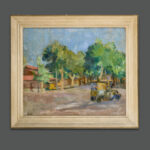
Largely self-taught, Natili approached painting within the cultural climate of the Roman School and Roman Tonalism. His early work focused particularly on landscapes, still lifes and figures, constructed through carefully balanced space and a sensitive use of light and colour.
He made his public debut in Rome in 1940 in a group exhibition at the Galleria di Roma. In 1941 he received second prize at the Premio Bergamo for a still life, while in 1942 he again exhibited at the Galleria di Roma alongside Franco Gentilini, Rolando Monti, Giovanni Stradone and Renato Marino Mazzacurati.
War, anti-Fascism and social commitment
During the war years Natili was active within Roman anti-Fascist circles. In 1944 he took part in Arte contro la barbarie, one of the significant artistic events held in Rome around the time of Liberation. He also participated in its second edition in 1951, organised as a protest against the Korean War.
After the war, his interest in social reality became increasingly pronounced. His painting entered the Neo-Realist debate and addressed themes connected with the human figure, labour and contemporary social conditions. The Quadriennale archive places Natili within this context alongside artists such as Renato Guttuso, Pericle Fazzini and Mario Mafai.
The Rome Quadriennale and the Roman art scene
Natili participated in the 4th Rome Quadriennale in 1943 and subsequently took part in four further editions up to 1960. This continued presence reflects his established position within post-war Roman art.
In 1945 he also joined the Libera associazione delle arti figurative. During these years he came into contact with Roberto Melli, Afro, Salvatore Scarpitta, Leoncillo and Giulio Turcato, as well as critics Marcello Venturoli and Emilio Villa.
From Realism to Informal Art
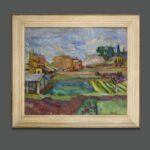
During the 1950s Natili’s painting became increasingly structured. Landscapes, figures and compositions were organised through warm light and broad spatial relationships, while his subject matter remained connected with post-war reality.
From the late 1950s and particularly during the 1960s, his work changed progressively. Pictorial matter gained greater autonomy, gesture became more forceful and forms gradually moved away from naturalistic description.
His painting consequently approached Abstract Expressionism and Italian Informal Art. Nevertheless, traces of figure and reality often remained beneath the surface, creating a persistent tension between image and matter.
Solo exhibitions and critical reception
Natili held his first solo exhibition at the Galleria San Marco in Rome in 1953. A further exhibition followed at the Galleria La Cassapanca in 1956, and in 1963 he returned to the Galleria San Marco for another solo show.
For the 1963 exhibition, critic and poet Emilio Villa wrote the introductory text for the catalogue. The publication is also documented in the Collezioni Digitali Reggiane.
In 1966 Natili also participated in the exhibition Collezione Roma at the Galleria Ferro di Cavallo.
Aldo Natili and Studio d’Arte Palma
Some works by Natili bear the original label of the Studio d’Arte Palma in Rome.
Founded in May 1944 by Pietro Maria Bardi, Studio d’Arte Palma represented an innovative model within the Italian art system. It combined exhibitions, art dealing, restoration, expertise and photographic documentation within a single organisation.
The original Studio Palma labels preserved on works currently held by Egidi MadeinItaly therefore provide important documentary evidence for their provenance.
Works in public collections
The Galleria del Premio Suzzara preserves Uccisione di un bracciante, an important example of Natili’s socially engaged Realist period.
Natili is also represented in the INPS art collections.
His 1946 painting Terrazze verso San Pietro belongs to the BNL Gruppo BNP Paribas Collection and has been included in exhibitions devoted to post-war Roman painting.
Natili continued working until the final years of his life, gradually withdrawing from public activity partly for health reasons. He died in Rome in 1975.
Available work in the gallery
You have a work by Aldo Natili and you want to sell it?
Call us at +39 3356585431 or send us a message on WhatsApp at +39 3356585431
YOU CAN TRUST US
The highest valuations, expertise, and reliability
Appraisals, purchases and sale of the works by this artist