

Arte salvata. Masterpieces beyond the war from the MuMa in Le Havre, held at M9 Museum in Mestre from March 15 to August 31, 2025, brought together more than fifty works from the French museum’s collections. The paintings we admired during our visit remain vivid in our memory, together with the story of their preservation.
For us, it was also an opportunity to rediscover familiar artists. During our years in Paris, between galleries and auctions, the names of Claude Monet, Eugène Boudin, and Raoul Dufy were often part of our daily lives. Seeing their works again in Mestre renewed that connection with French painting.
Arte salvata at M9 and the memory of war
Curated by Marianne Mathieu and Géraldine Lefebvre, the exhibition formed part of the commemorations marking the eightieth anniversary of the end of World War II. Its guiding theme was the relationship between artistic heritage, memory, and reconstruction.
Alongside the paintings, photographs and documents recalled the bombing of Mestre, particularly the raid of March 28, 1944. They established a dialogue with Le Havre, another port city deeply affected by the conflict. The exhibition traced the rescue of the collections and their later growth, extending its story into the postwar years.
MuMa in Le Havre and the formation of its collections
The Musée d’art moderne André Malraux, known as MuMa, holds one of France’s major collections of Impressionist painting outside Paris. Its history goes back to the museum inaugurated in 1845 and is closely connected with a city receptive to trade and new artistic developments.
Collectors such as Charles-Auguste Marande and Olivier Senn played a decisive role in shaping this heritage. The Marande bequest entered the museum in 1936. In 2004, Hélène Senn-Foulds donated the collection of her grandfather Olivier Senn, strengthening the museum’s holdings of Impressionist, Post-Impressionist, and Fauve art.
The history of MuMa’s collections
From destruction to reopening
The bombing of September 1944 destroyed the old museum. Around 1,500 paintings, moved to places of safety during the war, were spared. The sculpture collection left in the building, however, was almost entirely lost.
The new museum was inaugurated on June 24, 1961, by André Malraux, then France’s Minister of Culture. Its opening returned the collections to the city, within a building also intended for concerts, talks, and cultural activities.
Meanwhile, the reconstruction led by Auguste Perret had reshaped Le Havre. The rebuilt city center was inscribed on the UNESCO World Heritage List in 2005.
Eugène Boudin and the painting of the sky
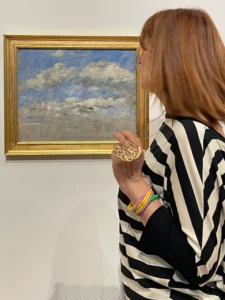
Among the first moving encounters of our visit was Eugène Boudin’s Study of Clouds over a Blue Sky. With such a simple subject, the sky becomes the focus of our attention. Looking at the painting means pausing over shifts in light and the sensitivity with which the artist captures a passing phenomenon.
The painting brought to mind the words of Federico Zeri, who wrote about certain French landscapes:
“…there is more than a description of the landscape. In fact, they contain a series of other elements that we cannot grasp unless we take into account certain Enlightenment theories, developed in particular by Montesquieu, according to which the climate and the appearance of the sky and landscape would explain the character of populations.” Federico Zeri
Boudin played a fundamental role in Monet’s artistic development. In 1900, his brother Louis donated Eugène’s studio holdings to Le Havre: 240 painted studies, according to MuMa’s history of its collections. This group offers an intimate view of the artist’s daily work before nature.
Monet and Renoir in Arte salvata
French Impressionism transformed the observation of contemporary life and landscape, placing light and the perception of color at the heart of painting. The group’s first independent exhibition opened in Paris on April 15, 1874. Monet, Renoir, Degas, Morisot, Pissarro, and Sisley were among its leading figures.
→ Explore the history of Impressionism
Claude Monet grew up in Le Havre and maintained a lasting connection with the city. In 1910, he offered three paintings to its museum, including The Houses of Parliament, London, also known as The Houses of Parliament, London, Effect of Fog, painted in 1903.
The loans to Mestre included five of MuMa’s six paintings by Monet. In the London painting, the building’s silhouette emerges through the fog: architecture becomes a means of exploring light and its transformations.
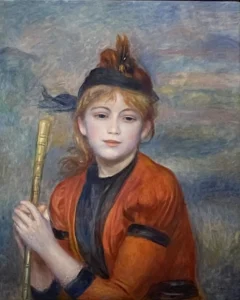
We also remember Pierre-Auguste Renoir’s The Excursionist, painted around 1888. Alongside views and landscapes, it brought the Impressionists’ interest in the human figure into the exhibition.
Fauvism and the role of Le Havre
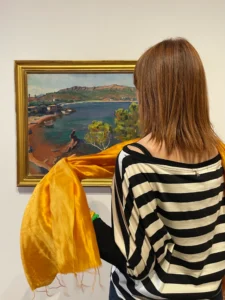
In the early twentieth century, Fauvism gave color a new freedom. Intense tones, simplified forms, and energetic brushwork expressed the painter’s vision, moving away from strict correspondence with natural colors. The Salon d’Automne in Paris in 1905 was a decisive moment in the emergence of these experiments.
Le Havre played an important role through Raoul Dufy and Othon Friesz, both born in the city, and their connections with Georges Braque, Albert Marquet, and Charles Camoin. The works on display traced the move toward a more independent and expressive use of color.
Symbolism and the Nabis
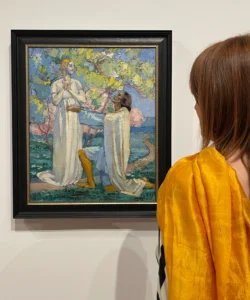
The exhibition also included works by Paul Gauguin, Jean-Francis Auburtin, Ker-Xavier Roussel, Maurice Denis, and Marie Droppe. Their presence opened a view onto the symbolic and decorative dimensions of painting around the turn of the twentieth century.
Symbolism favored suggestion and inner experience. The work of the Nabis, whose members included Denis and Roussel, also belongs within this broader context. Color and composition could suggest moods and meanings extending beyond the immediate description of a subject.
Georges Braque and Boat on the Shore
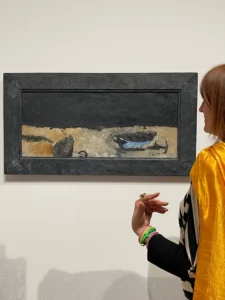
Near the end of the exhibition, Georges Braque’s Boat on the Shore, or Barque sur la grève, introduced another moment in twentieth-century painting. Created in 1956, it belongs to the artist’s late period and his renewed interest in landscape.
The painting entered MuMa in 2019 through the bequest of Florence Malraux, André Malraux’s daughter. Its presence therefore also illustrated the continuing role of collecting and donations after the war.
Remembering Arte salvata through painting and music
A pleasant surprise during our visit was the musical selection curated by Dario Falcone. Pieces by Debussy, Ravel, Messiaen, Malipiero, Bach, Mozart, and Chopin accompanied the paintings, inviting us to linger and listen.
What remains of Arte salvata is the memory of the paintings and of the people who made their preservation possible. Looking at them again with an understanding of their history gives a different weight to the time spent before a canvas.
To continue this exploration, read our introduction to modern art or browse the gallery’s selection.
→ Discover the history and movements of modern art
→ Explore modern artworks available in our gallery
The exhibition on the M9 Museum website