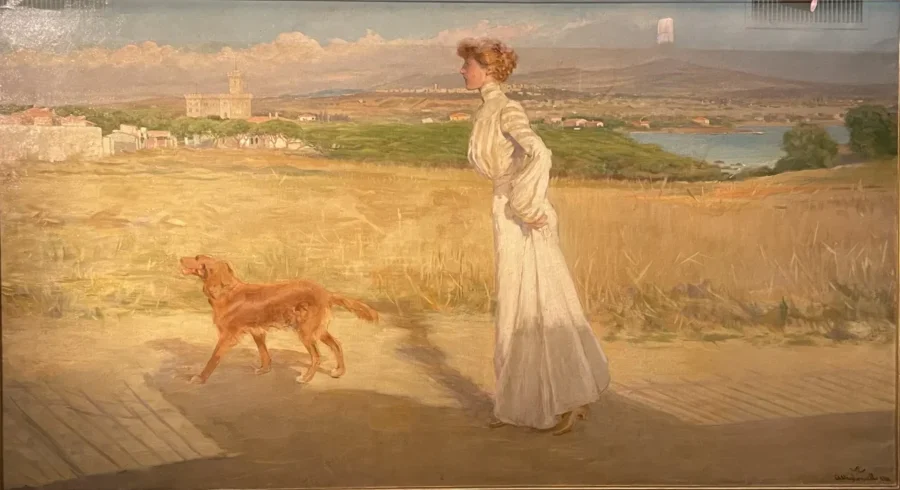
The “Belle Époque” Exhibition
The Belle Époque exhibition, open from October 15, 2025 to April 7, 2026 at Palazzo Blu in Pisa, is more than just a display: it’s a time-machine transporting you from a war-scarred and revolt-ridden Europe into an era of shimmering lights, where art danced with everyday life.
Curated by Prof. Francesca Dini, and featuring extraordinary loans from the Musée d’Orsay, the Louvre Museum, the Gallerie degli Uffizi, the Philadelphia Museum of Art, the Museo e Real Bosco di Capodimonte, and Palazzo Te — plus treasures from private collections exhibited for the first time.
What does “Belle Époque” mean?
The term, coined with a touch of nostalgia in the 1920s, literally means “beautiful era” in French. It refers to the historical period between 1871 and 1914, a time of relative peace in Europe after France’s defeat at Sedan and the repression of the Paris Commune.
It was an age of bourgeois prosperity, of dazzling innovations — from fast trains to electric lights, from World’s Fairs to Paris cabarets — and of a wealth that permeated art, literature, music and fashion.
Paris: capital of the 19th century
Paris became the beacon of this joie de vivre. Flâneurs strolled along the boulevards, while elegantly dressed women carried parasols through the city. Theatres were crowded, and illustrated newspapers spread images of glamour and modern life. However, this was not merely a world of superficial beauty. It was also a golden illusion before the trauma of the Great War. In many ways, the Belle Époque celebrated a new secular and liberal modernity that influenced the whole of Europe, including Italy.
Yet, this brilliant era emerged from a period of profound political and social turmoil. The exhibition recalls France’s defeat at Sedan in 1870, the fall of Napoleon III, the Prussian siege and the Paris Commune. The revolutionary experience of the Commune lasted only a few months before being violently suppressed.
In this context, the paintings of Gustave Courbet, one of the leading figures of Realism, expressed a powerful spirit of rebellion. Courbet also supported the dismantling of the Vendôme Column, which he regarded as a symbol of political and military power. Meanwhile, Édouard Manet portrayed the turmoil of contemporary life with uncompromising brushwork. Maximilien Luce, in turn, documented the violence and bloodshed that marked the streets of Paris.
What was happening in Italy?
Giuseppe Garibaldi intervenes in his last Risorgimento campaign in Dijon, portrayed by Carlo Ademollo and Sebastiano De Albertis — painters who wield brush like sword. It’s the end of the soldier-artist and the dawn of the painter-flâneur, that urban wanderer theorized by Charles Baudelaire: “a sensual observer of modern life, who rejoices in ‘elegant carriages, superb horses and slender women’.”
Ernest Meissonier ends that chapter with canvases that whisper: heroism dies, but the city is reborn.
“I cannot yet bring myself to leave this Paris of mine for a moment, I cannot detach myself but with great sorrow.” — Giovanni Boldini
Boldini and De Nittis in Paris: the glamour of painting “à la mode”
Italian artists like Boldini and De Nittis capture post-crisis Parisian lightness. Their spirited, refined style embodies joie de vivre, with virtuosic strokes celebrating the new vital rhythm: fast trains, advertising posters and mass tourism.
Here burst onto the scene the Italian painters in Paris, those bold artistic emigrants who turned the Ville Lumière into their laboratory.
Giovanni Boldini
Giovanni Boldini, the “master of the vortex” from Ferrara, arrives in 1871 and conquers the salons with feverish brushstrokes, painting women who seem to dance in the wind — as in “On the Bench in the Bois”, depicting a thoughtful girl on a bench in the Bois de Boulogne, Paris’s most elegant park. The identity of the model remains an unresolved mystery.
Completed just a year after Boldini’s arrival in Paris, it captures his first encounter with Parisian joie de vivre, mixing intimate portraiture and Impressionist touches in lush greens and red flowers.

Giuseppe De Nittis
Giuseppe De Nittis, the barlettano with an Impressionist touch, settles in 1867, marries Léontine Gruvelle and opens his home as a cosmopolitan salon: Degas, Manet, Zola, Oscar Wilde and even Princess Mathilde Bonaparte discuss art over pastel and tea. His “Breakfast in the Garden” captures family intimacy with golden backlighting, a poignant farewell before his premature death at 38. He embraces Monet’s light but with a southern elegance.

Federico Zandomeneghi
Then comes Federico Zandomeneghi, the Venetian Macchiaiolo who in 1874 joins the Impressionists thanks to Degas, painting “The Cook” with vibrant strokes that fuse daily humanism and avant-garde. He mediates between Degas and domestic reality.
These Italians are not outsiders: they are the chroniclers of the metropolis, flâneurs who steal the scene from the French. Influenced by Impressionism but with an Italian soul — more narrative, more sensual — they capture fragments of existence shimmering like a modern Watteau.
They export the “European female cliché”: women in déshabillé, Paris salons, a symbol of modernity scented with silk and ambition.
La Maison Goupil
At the center of this whirlwind sits the Maison Goupil, the beating heart of the nineteenth-century art market.
Founded in 1829 by Adolphe Goupil, this Parisian gallery-publisher — with branches in Europe and the USA — didn’t just sell paintings: it spread art “à la mode”, accessible and bright. Small formats, dating scenes, technical virtuosity for bourgeois collectors hungry for glamour. Here Boldini and De Nittis find refuge and success, leaning on a network that turns art into global product.
Mariano Fortuny y Marsal
The true star is Mariano Fortuny y Marsal, the Catalan dominating the 1870s: his “Beach at Portici” (1874) — exhibited for the first time in Italy — converses with Boldini’s “Main Road at Combes-la-Ville” and De Nittis’s “The Mill of Castellammare” in a dazzling naturalism.
During his 1874 summer stay at Portici (near Naples), Fortuny inspires Southern Italian painting — Antonio Mancini,Francesco Paolo Michetti, Alceste Campriani — opening Italy to the European market.

A little-known detail about Fortuny’s painting “Beach at Portici”
“Beach at Portici” is not only one of the most luminous and modern landscapes by the Catalan master. It is also his last unfinished painting. Created during the summer of 1874 in a seaside villa at Portici, near Naples, the work depicts the artist’s family at leisure. Among the figures are his wife, Cecilia de Madrazo, and his son Mariano. In the background, the Bay of Naples opens towards Mount Vesuvius.
Only a few months later, Fortuny died suddenly at the age of 36, leaving the painting unfinished. The figures seem to emerge from the canvas through free and vibrant brushstrokes. At the same time, the scene captures a moment of Mediterranean joie de vivre that anticipates some aspects of Impressionism.
Moreover, the painting has an important recent exhibition history. Acquired by the Meadows Museum in Dallas in 2018, it is presented in Italy at the Belle Époque exhibition at Palazzo Blu in Pisa. Here, it enters into dialogue with works by Boldini and De Nittis.
In this context, Goupil became a true factory of dreams. Through prints and lithographs, the company built an international art empire and brought works of art to an increasingly wide public. Italian painters played a major role in this sophisticated commercial and cultural network.
The Belle Epoque in Tuscany : Parisian echoes between sea and hills.
Between the end of the nineteenth century and the beginning of the twentieth, Tuscany was not only a land of the ancient Renaissance, but a lively laboratory where the charm of the Belle Époque blended with local soul, creating a unique harmony between tradition and modernity.
Imagine Florence, Livorno and their coasts as satellites of Paris: the French capital, epicenter of modern art, inspires an uninterrupted dialogue thanks to artists’ stays at Universal Expositions — events that mix electric lights, innovations and cosmopolitan dreams. Here, painting renews itself by absorbing naturalism, society portraits and Impressionist strokes, reworked with a personal touch fragrant with olive trees and the Tyrrhenian Sea.

Reading by the Sea by Vittorio Corcos
In the midst of this spirit pulses a refined taste for domestic intimacy, seaside chic and suspended dreams, captured in an elegant style that elevates everyday life to poetry. Its highest expression is “Reading by the Sea” (1910) by Vittorio Corcos, a masterpiece evoking the Tuscan Belle Époque with its beach scene: a woman immersed in a book, surrounded by young people on the pier, under a sky mirrored in the Tyrrhenian Sea. It’s an invitation to summer relaxation, perfect for those visiting the exhibition at Palazzo Blu and looking for “Made in Italy” inspiration.