


Virgilio Guidi was born in Rome in 1891 and died in Venice in 1984. He was a prominent Italian painter, poet, and essayist. His artistic training began early, first in the workshop of the restorer and decorator Giovanni Capranesi and later at the Rome Academy of Fine Arts, where he studied under Giulio Aristide Sartorio from 1911. He soon distanced himself from Sartorio’s Symbolist and decorative approach and developed a more personal investigation of form, colour and light.
Giotto, Piero della Francesca, Cézanne and Matisse became important points of reference. Guidi also responded to the work of Armando Spadini, but gradually developed an autonomous pictorial language based on compositional balance, plastic synthesis and luminosity.
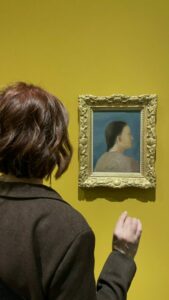
Rome and the Roman Secession
Guidi took part in the Roman Secession and began exhibiting regularly during the 1910s.
Rome provided a decisive intellectual and artistic environment. During the following decade, he progressively developed a balance between classical structure and modern pictorial language.
Light remained central to this process and became one of the defining elements of his work.
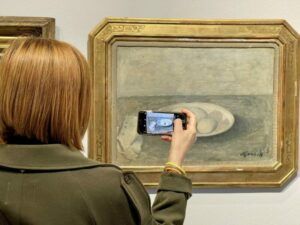
Novecento Italiano and In tram
Guidi participated in exhibitions associated with Novecento Italiano, although he maintained a strongly independent position within the broader movement.
One of the key works of this period is In tram, painted in 1923 and shown at the Venice Biennale in 1924.
The painting transforms an everyday urban subject through rigorous composition and suspended light. The monumental treatment of the figures recalls Piero della Francesca, while the modern subject gives the scene a distinctly twentieth-century character.

Venice and the study of light
At the end of the 1920s, Guidi was appointed professor of painting at the Venice Academy of Fine Arts, succeeding Ettore Tito. The move to Venice marked a crucial change in his career.
Venetian light became one of the central subjects of his research. Seascapes, lagoon views and figures were increasingly reduced to essential relationships between colour and space.
In 1935 he moved for a period to Bologna, where he also taught at the Academy. Nevertheless, his connection with Venice remained fundamental.
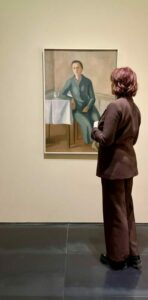
From figure to space
After the Second World War, Guidi pushed his investigation of light and space further.
The figure did not disappear, but became increasingly simplified. Faces, bodies, skies and seascapes were transformed into luminous structures that at times approached abstraction.
During the late 1940s and 1950s, Guidi also came into contact with the Venetian Spatialist environment, while preserving his own independent artistic language.
His later work developed through recurring cycles such as Figures in Space, Seascapes, Heads, Presences and Cosmic Architectures. In his final years, white became increasingly dominant in compositions concerned with light, space and the human presence.
Guidi died in Venice in 1984.
You have a work by Virgilio Guidi and you want to sell it?
Call us at +39 3356585431 or send us a message on WhatsApp at +39 3356585431
YOU CAN TRUST US
The highest valuations, expertise, and reliability
Appraisals, purchases and sale of the works by this artist