


David Wilkie and the art of everyday life
David Wilkie (1785-1841) found compelling stories in everyday encounters. A gesture or a glance reveals a character’s temperament, while light draws attention to the telling moment. The Scottish painter established his career in London, becoming known for genre scenes and portraits before expanding into historical and religious painting.
David Wilkie from Scotland to London
Born in Cults, Fife, Wilkie was the son of a country minister. He entered Edinburgh’s Trustees’ Academy at fifteen. Village celebrations, weddings, and gatherings at inns soon offered subjects through which he could explore habits and human relationships.
In 1805, he moved to London to study at the Royal Academy Schools. His work quickly attracted influential supporters. Sir George Beaumont commissioned The Blind Fiddler, now in the Tate collection, and the collector John Julius Angerstein also became a patron. Wilkie was elected a full member of the Royal Academy in 1811.
Storytelling through gesture and light
Dutch and Flemish painting helped shape his approach. The works of Adriaen van Ostade, David Teniers, and Rembrandt offered models for arranging interiors, observing character, and giving light an expressive role.
In David Wilkie’s paintings, however, detail does more than describe a setting. It helps the story unfold. Figures respond to one another, inviting viewers to consider what has happened and what might follow. Alongside these lively group scenes, A Young Woman kneeling at a Prayer Desk, painted in 1813, reveals a quieter sensitivity to a solitary figure.
European travels and royal appointments
In 1823, Wilkie became King’s Limner for Scotland. He then traveled through France, Italy, and Spain between 1825 and 1828. Studying Titian, Correggio, and Velázquez encouraged broader brushwork and an increasing interest in historical subjects.
Appointed Painter in Ordinary to George IV in 1830, he retained the position under William IV and Queen Victoria. He received a knighthood in 1836. His reputation also reached continental Europe, where the Crown Prince of Bavaria acquired a painting for his gallery in Munich.
His final journey and Turner’s tribute
In 1840, Wilkie traveled to the Middle East, hoping to bring a fresh understanding to religious painting through direct encounters with the people and places of the Holy Land. He died at sea in 1841 on the return journey. Turner commemorated his burial in Peace Burial at Sea, now in the Tate collection.
A painting by David Wilkie at the gallery
Egidi MadeinItaly offers The Parish Beadle, an oil on canvas dated to around 1820-1823. Christie’s catalogs it as a full-scale sketch for the painting of the same name at Tate Britain. The encounter between a parish official and a group of itinerant performers conveys Wilkie’s understated humor.
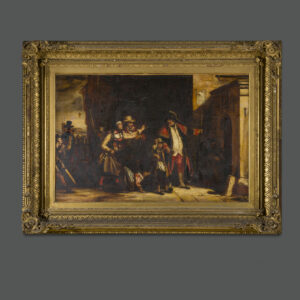
View the painting for further details and purchase inquiries. Its wider artistic context is explored in our guide to 19th-century painters in Italy and Europe.
You have a work by Sir David Wilkie and you want to sell it?
Call us at +39 3356585431 or send us a message on WhatsApp at +39 3356585431
YOU CAN TRUST US
The highest valuations, expertise, and reliability
Appraisals, purchases and sale of the works by this artist