


Juanita Preval Piccoli (Milwaukee, 1904 – Anticoli Corrado, 1997) was an American painter and illustrator whose artistic career unfolded between the United States and Italy, engaging with some of the most distinctive developments in twentieth-century figurative culture. From the politically engaged graphic work of the 1920s and 1930s to the paintings of her mature years, her practice gradually evolved toward a language in which Post-Impressionist influences, chromatic freedom, and a tendency toward abstraction coexist with a sustained interest in the human figure and landscape.
Juanita Preval in the United States: Drawing, Graphic Art, and Social Engagement
The earliest documented phase of Juanita Preval’s career developed within the sphere of American graphic art associated with progressive and radical publishing.
As early as 1926, her name appeared among the artists included in Red Cartoons from The Daily Worker, The Workers Monthly and The Liberator, a collection of political drawings and cartoons published in Chicago by the Daily Worker Publishing Company. Alongside Preval were illustrators and cartoonists such as William Gropper, Hugo Gellert, Art Young, Adolf Dehn, and Robert Minor.
Her graphic work was not merely decorative, but belonged to a visual culture that regarded imagery as a means of testimony and social intervention. In June 1931, the Daily Worker published under her name an illustrated sequence devoted to the well-known Scottsboro Boys case.
In 1932, Preval also worked as a book illustrator. She created the illustrations for Helen Kay’s Battle in the Barnyard: Stories and Pictures for Workers’ Children and illustrated Myra Page’s Gathering Storm: A Story of the Black Belt.
Juanita Preval and Girolamo Piccoli
Juanita Preval married the sculptor Girolamo Piccoli, also known as Nemo Piccoli. Around 1928, the couple settled in New York, where the two artists shared a studio.
Their involvement in American left-wing circles had decisive consequences during the Cold War. The couple was placed on lists of alleged Communist sympathizers, and in the 1950s they left the United States and moved to Italy.
The transition from the American art world to the Italian cultural milieu represents a crucial turning point in Juanita Preval’s biography.
The Painting of Juanita Preval Piccoli in Italy
In Italy, the painter found in Anticoli Corrado a place of particular significance. The small town in Lazio, historically frequented by Italian and foreign painters and sculptors, became her home for the final forty years of her life.
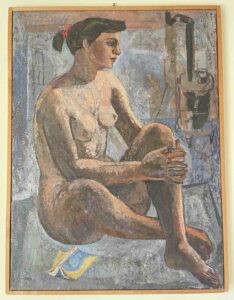
In 1956, Juanita Preval Piccoli donated her Female Nude, a signed and dated oil on canvas, to the Civic Museum of Anticoli Corrado. The figure, seated cross-legged in a domestic interior, is rendered through a pictorial language that preserves the observable world without lapsing into descriptive naturalism.
The everyday character of the interior, the presence of the stove, and the shoes placed beside the figure lend the composition an intimate and anti-rhetorical quality. Color gradually begins to acquire greater autonomy from mere description, anticipating the expressive freedom that would characterize part of her later work.
The 1961 Rome Exhibition and Carlo Levi
An important record of the artist’s exhibition activity in Italy is provided by the show organized in Rome at La Medusa Studio d’Arte, which opened on April 5, 1961.
The exhibition invitation, now documented in the bibliographic collections of the Mart in Rovereto, bears the title Juanita Prèval Piccoli and includes a text by Carlo Levi. The presence of the Turin-born writer and painter in the publication attests to the artist’s integration into the Roman cultural milieu of the early 1960s.
From the Figure to the Landscape: The Mature Works
The later production of Juanita Preval Piccoli reveals a progressive emancipation of pictorial matter and color.
In addition to the 1956 Female Nude, the Museum of Anticoli Corrado also preserves Bacchanal, datable to around 1975, and Landscape of Anticoli, a tempera on paper from 1987.
Her artistic development therefore traces a path in which figuration is never entirely abandoned, but is increasingly subjected to formal synthesis. According to the Museum of Anticoli Corrado, her work displays both Post-Impressionist and abstract elements, a characterization that helps explain the growing freedom with which she approached surface, line, and color.
Anticoli Corrado thus became not only Juanita Preval’s final place of residence, but also one of the central iconographic subjects of her late painting.
Juanita Preval Piccoli within Twentieth-Century Art
Juanita Preval Piccoli occupies a distinctive position in twentieth-century art history. American by birth and by the circumstances of her early professional career, and Italian by adoption during the second half of her life, she moved through profoundly different artistic environments and visual languages.
The socially engaged American graphic art of the 1920s and 1930s, editorial illustration, figurative painting, and her later openness to Post-Impressionist and abstract developments define an artistic trajectory that was far less linear than the relatively sparse biographical accounts devoted to her have often suggested.
The presence of her works in the collections of the Civic Museum of Modern and Contemporary Art of Anticoli Corrado, together with the documentation of the 1961 Rome exhibition introduced by Carlo Levi, now makes it possible to reconstruct her artistic personality and career with greater precision.
You have a work by Juanita Preval Piccoli and you want to sell it?
Call us at +39 3356585431 or send us a message on WhatsApp at +39 3356585431
YOU CAN TRUST US
The highest valuations, expertise, and reliability
Appraisals, purchases and sale of the works by this artist