


The Gulf Prize between Futurist avant-garde and post-war research.
The Premio del Golfo della Spezia is one of the most important and long-standing awards in Italian contemporary art. Established after World War II, it has made a decisive contribution to promoting artists who have marked the history of 20th-century art, maintaining strong ties with the local area and Italian visual culture.
The Futurist Foundation
The award was officially established in 1933 on the initiative of Filippo Tommaso Marinetti, founder of Futurism, together with Tullio d’Albisola Righetti, Enrico Prampolini, and Fillia.
Set against the backdrop of the great Futurist exhibitions, the award aimed to promote painting capable of interpreting:
dynamism, modernity, relationship between art, technology, and landscape
The first edition took place in La Spezia between September and November 1933, placing the Gulf at the center of the national artistic debate. Among the protagonists of this phase was Gerardo Dottori, a central figure in aeropainting.
Post-war reconstruction
After the interruption caused by World War II, the Prize was re-established in 1949 on the initiative of the Municipality of La Spezia and critics active on the national scene.
This second season marked the moment of greatest historical and collectible significance for the Prize.
It was in this context that:
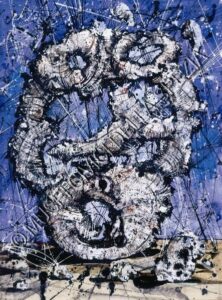
Gian Carozzi won First Prize in 1949 with Metamorfosi della Grotta Azzurra (Metamorphosis of the Blue Grotto), the Prize became a privileged observatory on post-war Italian art.
Artists and protagonists
Over the course of its editions, the Premio del Golfo has seen the participation and recognition of artists who are now central figures in the history of Italian art, including:
-
Gian Carozzi
-
Renato Guttuso
-
Emilio Vedova
-
Ennio Morlotti
-
Giuseppe Santomaso
The dialogue with circles close to Lucio Fontana’s Spatialism and European Informalism further strengthens the international profile of the Prize.
Technical features and languages
The Gulf Prize stands out for its extraordinary linguistic openness:
– from Futurist and Aeropictorial painting
-to the informal material
-to lyrical and gestural abstraction
This diversity reflects the evolution of Italian art over three crucial decades of the twentieth century.
Gulf Prize. An “uncomfortable” award
From its earliest futurist editions, the Gulf Prize stood out for its bold and divisive choices. Some works provoked strong reactions from more traditional audiences, especially for their use of color and decomposition of form.
From Futurism to Informal Art
One of the most fascinating aspects of the Prize is its ideological transformation:
-
in the 1930s, celebration of modernity and dynamism
-
in the post-war period, reflection on matter, gesture, and the human condition
Few Italian awards can boast such continuity across such diverse languages.
Works entered into public collections
Several works that have won awards or been exhibited at the Premio del Golfo have been added to the civic collections of La Spezia (now CAMeC) over time, reinforcing the museum and documentary value of the award.
A silent springboard
For artists such as Gian Carozzi, the Premio del Golfo was not only an award, but a real turning point: an award capable of opening doors to galleries, critics, and institutions, without media hype but with great critical weight.