


Plinio Nomellini
Plinio Nomellini (1866-1943) was a prominent Italian painter, representative of Divisionism and Symbolism.
Born in Livorno to a bourgeois family, his father was a customs official.
He began his artistic training with Natale Betti and continued at the Academy of Fine Arts in Florence, under the guidance of Giovanni Fattori.
The beginning of the career and the first success
The first exhibitions
Nomellini made his debut in the art world in 1886, exhibiting at the Promoting Society of Fine Arts in Florence.
Success came in 1888 with the work Il fienaiolo (The Haymaker), now preserved in the Giovanni Fattori Civic Museum, chosen for the Exposition Universelle in Paris in 1889.
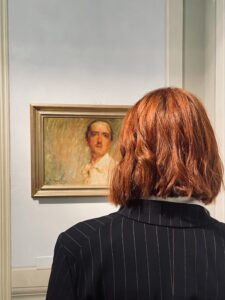
Self-Portrait Plinio Nomellini
Technique and surpassing the master Fattori
In the painting The Hay, the long strands of color surpass the “stain” technique of his master Fattori, anticipating the luminous research of Divisionism.
The Genoese period and social commitment
In 1890, he moved to Genoa, where he addressed social themes, representing the working class in works such as Piazza Caricamento (1891).
Here, he experimented with Divisionism, using fine strokes and pure colors for vibrant light effects.
Anarchy and symbolism
In 1894, he was arrested for his anarchist ideas. By the end of the century, he turned towards Symbolism, exploring inner dimensions, dreams, and the invisible.
Return to Tuscany and major collaborations
In 1902, he returned to Tuscany, to Torre del Lago, where he became friends with Giacomo Puccini and collaborated with Giovanni Pascoli.
Patriotic themes and adherence to the regime
In the 20th century, he tackled patriotic and historical themes, such as in the painting Garibaldi (1907), presented at the VII Biennale in Venice, and Incipit Nova Aetas (1924), linked to fascism.
Landscapes for the private market
In addition to works for public institutions, Nomellini created landscapes for the private market, characterized by vibrant colors and joyful atmospheres, which were highly appreciated by the public.
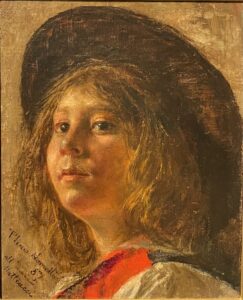
Head of a Ciociaro Plinio Nomellini
Exhibitions and recognitions
Participation in exhibitions
He participated in 21 editions of the Venice Biennale (from 1899 to 1942) and the I Quadriennale in Rome (1931).
He is a central figure of the Labronico Group, of which he became president in 1928.
Presence in public collections
In Livorno, his works are preserved in the Palazzo della Provincia, the Chamber of Commerce, and the Civic Museum, where he actively contributed to the cultural life.
The death of Plinio Nomellini
Plinio Nomellini died in Florence in 1943, at the age of 77, leaving a significant mark on Italian painting between the 19th and 20th centuries.
You have a work by Plinio Nomellini and you want to sell it?
Call us at +39 3356585431 or send us a message on WhatsApp at +39 3356585431
YOU CAN TRUST US
The highest valuations, expertise, and reliability
Appraisals, purchases and sale of the works by this artist